Documentation Revision Date: 2026-10-12
Dataset Version: 1
Summary
There are nine files in Portable Document Format (PDF) with this dataset.

Figure 1. Landcover across the ABoVE core domain, 2014. This figure is included in all files. Source dataset: Wang et al. (2019).
Citation
Banner, M., B. Bolster, E.E. Hoy, and L. Larson. 2026. ABoVE: Discovering Data at a Regional Level Booklets. ORNL DAAC, Oak Ridge, Tennessee, USA. https://doi.org/10.3334/ORNLDAAC/2480
Table of Contents
- Dataset Overview
- Data Characteristics
- Application and Derivation
- Quality Assessment
- Data Acquisition, Materials, and Methods
- Data Access
- References
Dataset Overview
This dataset provides booklets that describe a variety of example datasets and the range of study areas created through NASA's Arctic-Boreal Vulnerability Experiment (ABoVE), a NASA Terrestrial Ecology Field Campaign conducted in Alaska and western Canada which began in 2015. The booklets with selected data products are for the entire ABoVE domain, and for select regional areas including Bristol Bay, Dehcho, Fairbanks, Mackenzie Delta, Sahtu, Vuntut Gwitchin, Whitehorse, and the Yukon-Kuskokwim Delta. The eight regional files generally include the same example datasets and descriptions as the ABoVE Booklet, and also include the data mapped for the specific region.
Example datasets are described for the following study areas: Land use/Land Cover (LULC), Active Layer Thickness (ALT), total burn area, Aboveground Biomass Density (AGBD), fire ignitions, tree canopy cover, machine learning and CO2 emissions, and gridded CO2 and CH4 flux emissions. In addition, the Yukon-Kuskokwim Delta Booklet also contains an example dataset for lakes and pond occurrences in the Yukon-Kuskokwim Delta, and the ABoVE Booklet includes dataset examples pertaining to fall moose hunting seasons and particulate matter estimates.
ABoVE is a diverse large-scale study of the impacts of environmental change on arctic Arctic and boreal terrestrial and freshwater ecosystems and the implications of these changes on societal and ecological systems. The goal of this dataset is to make the data more widely available by highlighting example datasets and providing general explanations, spatial coverage, spatial and temporal resolution, temporal coverage, dataset citations, and data coverage maps.
Project: Arctic-Boreal Vulnerability Experiment
The Arctic-Boreal Vulnerability Experiment (ABoVE) was a field campaign conducted in Alaska and western Canada for nearly ten years, starting in 2015. Researchers participating in ABoVE linked field-based, process-level studies with geospatial data products derived from airborne and satellite sensors. The work provided a foundation for improving the analysis and modeling capabilities needed to understand and predict ecosystem responses to, and societal implications of, climate change in the Arctic and boreal regions.
Related Datasets
Chen, D., M. Billmire, N.H.F. French, T.V. Loboda, and A.E. Bredder. 2023. Simulated Fine Particulate Matter (PM2.5) Estimates over Alaska, 2001–2015. ORNL DAAC, Oak Ridge, Tennessee, USA. https://doi.org/10.3334/ORNLDAAC/2157
Chen, R.H., R.J. Michaelides, J. Chen, A.C. Chen, L.K. Clayton, K. Bakian-Dogaheh, L. Huang, E. Jafarov, L. Liu, M. Moghaddam, A.D. Parsekian, T.D. Sullivan, A. Tabatabaeenejad, E. Wig, H.A. Zebker, and Y. Zhao. 2022. ABoVE: Active Layer Thickness from Airborne L- and P-band SAR, Alaska, 2017, Ver. 3. ORNL DAAC, Oak Ridge, Tennessee, USA. https://doi.org/10.3334/ORNLDAAC/2004
Duncanson, L., P.M. Montesano, A. Neuenschwander, N. Thomas, A. Mandel, D. Minor, E. Guenther, S. Hancock, T. Feng, A. Barciauskas, G.W. Chang, S. Shah, and B.P. Satorius. 2023. Aboveground Biomass Density for High Latitude Forests from ICESat-2, 2020. ORNL DAAC, Oak Ridge, Tennessee, USA. https://doi.org/10.3334/ORNLDAAC/2186
Farina, M. K., & Watts, J. D. (2022). Gridded CO2 and CH4 Flux Estimates for pan-Arctic and Boreal Regions, 2003-2015 (Version 1). ORNL Distributed Active Archive Center. https://doi.org/10.3334/ORNLDAAC/2121
Feng, M., Sexton, J. O., Wang, P., Channan, S., Montesano, P. M., Wagner, W., Wooten, M. R., & Neigh, C. S. (2022). ABoVE: Tree Canopy Cover and Stand Age from Landsat, Boreal Forest Biome, 1984-2020 (Version 1). ORNL Distributed Active Archive Center. https://doi.org/10.3334/ORNLDAAC/2012
Hasbrouck, T., T.J. Brinkman, G. Stout, K. Kielland, and E. Trochim. 2019. ABoVE: Environmental Conditions During Fall Moose Hunting Seasons, Alaska, 2000–2016. ORNL DAAC, Oak Ridge, Tennessee, USA. https://doi.org/10.3334/ORNLDAAC/1739
Hessilt, T.D., B.M. Rogers, R.C. Scholten, S. Potter, T.A.J. Janssen, and S. Veraverbeke. 2023. ABoVE: Ignitions of ABoVE-FED Fires in Alaska and Canada. ORNL DAAC, Oak Ridge, Tennessee, USA. https://doi.org/10.3334/ORNLDAAC/2316
Loboda, T.V., J.V. Hall, D. Chen, A. Hoffman-Hall, V.S. Shevade, F. Argueta, and X. Liang. 2024. Arctic Boreal Annual Burned Area, Circumpolar Boreal Forest and Tundra, V2, 2002-2022. ORNL DAAC, Oak Ridge, Tennessee, USA. https://doi.org/10.3334/ORNLDAAC/2328
Luo, M., F. Li, D. Hao, Q. Zhu, H. Dashti, and M. Chen. 2024. Land Use and Land Cover Change Projection in the ABoVE Domain. ORNL DAAC, Oak Ridge, Tennessee, USA. https://doi.org/10.3334/ORNLDAAC/2353
Mullen, A., Watts, J. D., Levenson, E., Caraballo-Vega, J. A., Spradlin, C. S., & Carroll, M. L. (2026). Lakes, Ponds, and Partial Inundation in the Yukon Kuskokwim Delta, AK, 2019-2023 (Version 1). ORNL Distributed Active Archive Center. https://doi.org/10.3334/ORNLDAAC/2450
Potter, S., S. Veraverbeke, X.J. Walker, M.C. Mack, S.J. Goetz, J.L. Baltzer, C. Dieleman, N.H.F. French, E.S. Kane, M.R. Turetsky, E.B. Wiggins, and B.M. Rogers. 2022. ABoVE: Burned Area, Depth, and Combustion for Alaska and Canada, 2001–2019. ORNL DAAC, Oak Ridge, Tennessee, USA. https://doi.org/10.3334/ORNLDAAC/2063
Virkkala, A-M., S. Natali, B.M. Rogers, J.D. Watts, K. Savage, S.J. Connon, M.E. Mauritz-tozer, E.A.G. Schuur, D.L. Peter, C. Minions, J. Nojeim, R. Commane, C.A. Emmerton, M. Goeckede, M. Helbig, D. Holl, H. Iwata, H. Kobayashi, P. Kolari, E. Lopez-blanco, M.E. Marushchak, M. Mastepanov, L. Merbold, M. Peichl, O. Sonnentag, T. Sachs, M. Ueyama, C. Voigt, M. Aurela, J. Boike, G. Celis, N. Chae, T. Christensen, S. Bret-Harte, S. Dengel, H. Dolman, C. Edgar, B. Elberling, S.E. Euskirchen, A. Grelle, J. Hatakka, E.R. Humphreys, J. Jaerveoja, A. Kotani, L. Kutzbach, T. Laurila, A. Lohila, I. Mammarella, Y. Matsuura, G. Meyer, M.B. Nilsson, S.F. Oberbauer, S.J. Park, F.J.W. Parmentier, R. Petrov, A.S. Prokushkin, S. Zyrianov, C. Schulze, V.L. St.louis, E.S. Tuittila, J.P. Tuovinen, W. Quinton, A. Varlagin, D. Zona, and V.I. Zyryanov. 2021. The ABCflux Database: Arctic-Boreal CO2 Flux and Site Environmental Data, 1989–2020. ORNL DAAC, Oak Ridge, Tennessee, USA. https://doi.org/10.3334/ORNLDAAC/1934
Virkkala, A-M., B.M. Rogers, J.D. Watts, K. Arndt, S. Potter, I. Wargowsky, and S. Natali. 2024. Machine learning-based Arctic-boreal terrestrial ecosystem CO2 fluxes, 2001–2020. ORNL DAAC, Oak Ridge, Tennessee, USA. https://doi.org/10.3334/ORNLDAAC/2377
Wang, J.A., D. Sulla-Menashe, C.E. Woodcock, O. Sonnentag, R.F. Keeling, and M.A. Friedl. 2019. ABoVE: Landsat-derived Annual Dominant Land Cover Across ABoVE Core Domain, 1984–2014 https://doi.org/10.3334/ORNLDAAC/1691
Webb, E.E., E. Levenson, S.W. Cooley, and J. Maze. 2025. ABoVE: Lakes and Ponds Weekly Occurrence, 2016–2023. ORNL DAAC, Oak Ridge, Tennessee, USA. https://doi.org/10.3334/ORNLDAAC/2430
Whitcomb, J., Chen, R. H., Clewley, D., Kimball, J., Pastick, N. J., Yi, Y., & Moghaddam, M. (2024). ABoVE: Upscaled Active Layer Thickness in Northern Alaska, 2014-2017 (Version 1). ORNL Distributed Active Archive Center. https://doi.org/10.3334/ORNLDAAC/2332
Acknowledgments
This project was funded by the NASA ABoVE program (grant WBS 279924.05.06.01.56).
Data Characteristics
Spatial Coverage: Alaska and western Canada
ABoVE Reference Locations
Domain: Core ABoVE and Extended ABoVE
Spatial Resolution: varies
Temporal Coverage: 2014-01-01 to 2025-12-31
Temporal Resolution: once
Study Area: Latitude and longitude are given in decimal degrees.
| Site | Westernmost Longitude | Easternmost Longitude | Northernmost Latitude | Southernmost Latitude |
|---|---|---|---|---|
| Alaska and western Canada | -172.6172 | -35.5078 | 73.9893 | 42.9885 |
Data File Information
There are nine files in Portable Document Format (.pdf) with this dataset.
The file ABoVE_Domain_Booklet.pdf describes example datasets from across the ABoVE domain.
There are eight regional files named <Site>_Booklet.pdf, where <Site> is "Bristol_Bay", "Dehcho", "Fairbanks", "Mackenzie_Delta", "Sahtu", "Vuntut_Gwitchin", "Whitehorse", or "Yukon_Kuskokwim_Delta".
The eight regional booklets have dataset examples (Table 1) and provide maps to illustrate the data in the specific site areas. The dataset description pages include a data location map, brief descriptions on what the data show, how the data were produced, the dataset citation, spatial resolution, spatial coverage, temporal coverage and temporal resolution.
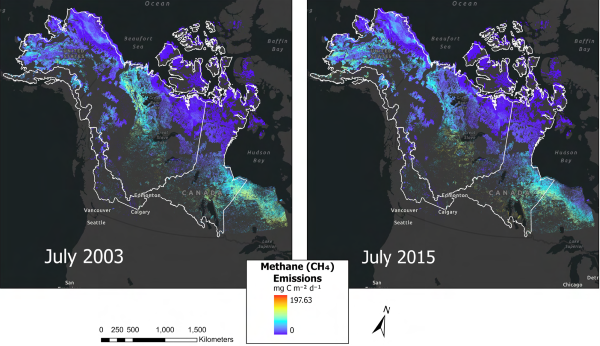
Figure 2. Gridded CO2 and CH4 Flux estimates for pan-Arctic and Boreal regions, 2003-2015. This dataset is included in the regional booklets and also in the ABoVE booklet. Source dataset: Farina and Watts (2022).
Table 1. Example datasets cited in the booklets.
| Datasets and Citations in Booklets | In all Booklets? |
|---|---|
| Wang, J.A., D. Sulla-Menashe, C.E. Woodcock, O. Sonnentag, R.F. Keeling, and M.A. Friedl. 2019. ABoVE: Landsat-derived Annual Dominant Land Cover Across ABoVE Core Domain, 1984-2014. https://doi.org/10.3334/ORNLDAAC/1691 | Yes |
| Loboda, T.V., J.V. Hall, D. Chen, A. Hoffman-Hall, V.S. Shevade, F. Argueta, and X. Liang. 2024. Arctic Boreal Annual Burned Area, Circumpolar Boreal Forest and Tundra, V2, 2002-2022. ORNL DAAC, Oak Ridge, Tennessee, USA. https://doi.org/10.3334/ ORNLDAAC/2328 | Yes |
| Chen, R.H., R.J. Michaelides, J. Chen, A.C. Chen, L.K. Clayton, K. Bakian-Dogaheh, L. Huang, E. Jafarov, L. Liu, M. Moghaddam, A.D. Parsekian, T.D. Sullivan, A. Tabatabaeenejad, E. Wig, H.A. Zebker, and Y. Zhao. 2022. ABoVE: Active Layer Thickness from Airborne L- and P- band SAR, Alaska, 2017, Ver. 3. ORNL DAAC, Oak Ridge, Tennessee, USA https://doi.org/10.3334/ORNLDAAC/1691 | Yes |
| Chen, D., M. Billmire, N.H.F. French, T.V. Loboda, and A.E. Bredder. 2023. Simulated Fine Particulate Matter (PM2.5) Estimates over Alaska, 2001-2015. ORNL DAAC, Oak Ridge, Tennessee, USA. https://doi.org/10.3334/ORNLDAAC/2157 | No-This dataset example is only in the ABoVE Domain Booklet |
| Potter, S., S. Veraverbeke, X.J. Walker, M.C. Mack, S.J. Goetz, J.L. Baltzer, C. Dieleman, N.H.F. French, E.S. Kane, M.R. Turetsky, E.B. Wiggins, and B.M. Rogers. 2022. ABoVE: Burned Area, Depth, and Combustion for Alaska and Canada, 2001-2019. ORNL DAAC, Oak Ridge, Tennessee, USA. https://doi.org/10.3334/ORNLDAAC/2063 | Yes |
| Virkkala, A-M., S. Natali, B.M. Rogers, J.D. Watts, K. Savage, S.J. Connon, M.E. Mauritz-tozer, E.A.G. Schuur, D.L. Peter, C. Minions, J. Nojeim, R. Commane, C.A. Emmerton, M. Goeckede, M. Helbig, D. Holl, H. Iwata, H. Kobayashi, P. Kolari, E. Lopez-blanco, M.E. Marushchak, M. Mastepanov, L. Merbold, M. Peichl, O. Sonnentag, T. Sachs, M. Ueyama, C. Voigt, M. Aurela, J. Boike, G. Celis, N. Chae, T. Christensen, S. Bret-Harte, S. Dengel, H. Dolman, C. Edgar, B. Elberling, S.E. Euskirchen, A. Grelle, J. Hatakka, E.R. Humphreys, J. Jaerveoja, A. Kotani, L. Kutzbach, T. Laurila, A. Lohila, I. Mammarella, Y. Matsuura, G. Meyer, M.B. Nilsson, S.F. Oberbauer, S.J. Park, F.J.W. Parmentier, R. Petrov, A.S. Prokushkin, S. Zyrianov, C. Schulze, V.L. St.louis, E.S. Tuittila, J.P. Tuovinen, W. Quinton, A. Varlagin, D. Zona, and V.I. Zyryanov. 2021. The ABCflux Database: Arctic-Boreal CO2 Flux and Site Environmental Data, 1989-2020. ORNL DAAC, Oak Ridge, Tennessee, USA. https://doi.org/10.3334/ORNLDAAC/1934 | No-The Booklets for Bristol_Bay, Vuntut_Gwitchin, and Yukon_Kuskokwim_Delta do not include this dataset example |
| Duncanson, L., P.M. Montesano, A. Neuenschwander, N. Thomas, A. Mandel, D. Minor, E. Guenther, S. Hancock, T. Feng, A. Barciauskas, G.W. Chang, S. Shah, and B.P. Satorius. 2023. Aboveground Biomass Density for High Latitude Forests from ICESat-2, 2020. ORNL DAAC, Oak Ridge, Tennessee, USA. https://doi.org/10.3334/ORNLDAAC/2186 | Yes |
| Hessilt, T.D., B.M. Rogers, R.C. Scholten, S. Potter, T.A.J. Janssen, and S. Veraverbeke. 2023. ABoVE: Ignitions of ABoVE-FED Fires in Alaska and Canada. ORNL DAAC, Oak Ridge, Tennessee, USA. https://doi.org/10.3334/ORNLDAAC/2316 | Yes |
| Luo, M., F. Li, D. Hao, Q. Zhu, H. Dashti, and M. Chen. 2024. Land Use and Land Cover Change Projection in the ABoVE Domain. ORNL DAAC, Oak Ridge, Tennessee, USA. https://doi.org/10.3334/ORNLDAAC/2353 | Yes |
| Feng, M., J.O. Sexton, P. Wang, S. Channan, P.M. Montesano, W. Wagner, M.R. Wooten, and C.S. Neigh. 2022. ABoVE: Tree Canopy Cover and Stand Age from Landsat, Boreal Forest Biome, 1984-2020. ORNL DAAC, Oak Ridge, Tennessee, USA. https://doi.org/10.3334/ORNLDAAC/2012 | No-The Yukon_Kuskokwim_Delta Booklet does not include this dataset example |
| Virkkala, A-M., B.M. Rogers, J.D. Watts, K. Arndt, S. Potter, I. Wargowsky, and S. Natali. 2024. Machine learning-based Arctic-boreal terrestrial ecosystem CO2 fluxes, 2001-2020. ORNL DAAC, Oak Ridge, Tennessee, USA. https://doi.org/10.3334/ORNLDAAC/2377 | Yes |
| Farina, M.K., and J.D. Watts. 2022. Gridded CO2 and CH4 Flux Estimates for pan-Arctic and Boreal Regions, 2003-2015. ORNL DAAC, Oak Ridge, Tennessee, USA. https://doi.org/10.3334/ORNLDAAC/2121 | Yes |
| Hasbrouck, T., T.J. Brinkman, G. Stout, K. Kielland, and E. Trochim. 2019. ABoVE: Environmental Conditions During Fall Moose Hunting Seasons, Alaska, 2000-2016. ORNL DAAC, Oak Ridge, Tennessee, USA. https://doi.org/10.3334/ORNLDAAC/1739 | No-This dataset example is only in the ABoVE Domain Booklet |
| Webb, E.E., E. Levenson, S.W. Cooley, and J. Maze. 2025. ABoVE: Lakes and Ponds Weekly Occurrence, 2016 - 2023. ORNL DAAC, Oak Ridge, Tennessee, USA. https://doi.org/10.3334/ORNLDAAC/2430 | No-This dataset example is only in the Yukon_Kuskokwim_Delta Booklet |
Application and Derivation
Over the past decade, the Arctic-Boreal Vulnerability Experiment (ABoVE) has brought together scientists, data analysts, government and community leaders, and Traditional and Indigenous knowledge holders to better understand the profound environmental changes unfolding across the Arctic and boreal regions. These collaborations have generated invaluable datasets spanning multiple science themes, including: carbon dynamics and fluxes, fire regimes and post-fire recovery, vegetation structure and aboveground biomass, permafrost thaw and soil carbon dynamics, subsistence resources and environmental conditions, hydrology and watershed dynamics, remote sensing and spectroscopy, land use and cover change, ecosystem disturbance and recovery, cryosphere dynamics and ice monitoring, human-environment interactions and climate impacts, ecosystem health, and biodiversity.
These themes advance scientific understanding and support planning and decision-making by local and Indigenous communities whose lands and livelihoods are directly impacted by these changes, as well as state/territorial and federal land managers with regional and national priorities. Each region within the ABoVE domain tells a unique story of changing landscapes, shifting ecosystems, and community resilience. Through the creation of regional one-pagers, some of ABoVE’s complex scientific findings have been distilled into accessible formats that can help residents make informed decisions. These region-specific summaries provide a bridge between cutting-edge science and the lived experiences of local and Indigenous peoples, ensuring that knowledge generated over the last decade serves those most affected by environmental change.
The legacy of ABoVE extends beyond datasets and maps created. It lives in the relationships built, the knowledge shared, and the commitment to ensuring that data generated in the Arctic and boreal regions serves the communities who call these lands home. Moving forward, the ABoVE scientists remain committed to upholding principles of Indigenous data sovereignty, fostering open-access science, and cultivating deeper partnerships that respect and honor the knowledge and perspectives of governments, rightsholders, and residents of the Arctic and boreal regions.
Quality Assessment
Not provided for this informational dataset. For quality assurance information on the datasets described in the booklets, users should refer to the dataset citations provided in the booklets at earthdata.nasa.gov.
Data Acquisition, Materials, and Methods
The ABoVE program conducted in Alaska and western Canada began in 2015. The goal of this dataset is to make ABoVE data more widely available by highlighting example datasets and providing general explanations, spatial coverage, spatial and temporal resolution, temporal coverage, dataset citations, and a map of the full extent that the data covers. Booklets are provided in PDF format that describe a variety of example ABoVE datasets with selected data products for the entire ABoVE domain, and for regional areas including Bristol Bay, Dehcho, Fairbanks, Sahtu, Vuntut Gwitchin, Mackenzie Delta, Whitehorse, and the Yukon-Kuskokwim Delta. The eight regional files generally include the same example datasets and descriptions as provided in the ABoVE Booklet, and also include the same data mapped for the specific region (refer to Figures 1 and 2). Example dataset topics described include Land use/land cover, Active Layer Thickness (ALT), total burn area, Aboveground Biomass Density (AGBD), fire ignitions, tree canopy cover, machine learning and CO2 emissions, and gridded CO2 and CH4 flux emissions. The Yukon_Kuskokwim_Delta Booklet also contains an example dataset for lakes and pond occurrence in the Yukon-Kuskokwim Delta. The ABoVE Booklet includes a dataset pertaining to fall moose hunting seasons, simulated fine particulate matter (PM2.5), and upscaled active layer thickness in Northern Alaska (Figure 3).
Refer to Section 2, Table 1, for a list of dataset citations used in this dataset.
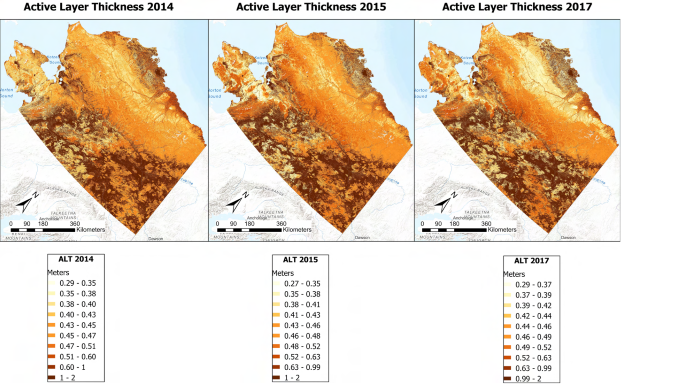
Figure 3. Comparison of active layer thickness over time. Sources: ABoVE_Domain_Booklet.pdf and Whitcomb et al. (2024) dataset.
Data Access
These data are available through the Oak Ridge National Laboratory (ORNL) Distributed Active Archive Center (DAAC).
ABoVE: Discovering Data at a Regional Level Booklets
Contact for Data Center Access Information:
- E-mail: uso@daac.ornl.gov
- Telephone: +1 (865) 241-3952
References
Chen, D., M. Billmire, N.H.F. French, T.V. Loboda, and A.E. Bredder. 2023. Simulated Fine Particulate Matter (PM2.5) Estimates over Alaska, 2001–2015. ORNL DAAC, Oak Ridge, Tennessee, USA. https://doi.org/10.3334/ORNLDAAC/2157
Chen, R.H., R.J. Michaelides, J. Chen, A.C. Chen, L.K. Clayton, K. Bakian-Dogaheh, L. Huang, E. Jafarov, L. Liu, M. Moghaddam, A.D. Parsekian, T.D. Sullivan, A. Tabatabaeenejad, E. Wig, H.A. Zebker, and Y. Zhao. 2022. ABoVE: Active Layer Thickness from Airborne L- and P-band SAR, Alaska, 2017, Ver. 3. ORNL DAAC, Oak Ridge, Tennessee, USA. https://doi.org/10.3334/ORNLDAAC/2004
Duncanson, L., P.M. Montesano, A. Neuenschwander, N. Thomas, A. Mandel, D. Minor, E. Guenther, S. Hancock, T. Feng, A. Barciauskas, G.W. Chang, S. Shah, and B.P. Satorius. 2023. Aboveground Biomass Density for High Latitude Forests from ICESat-2, 2020. ORNL DAAC, Oak Ridge, Tennessee, USA. https://doi.org/10.3334/ORNLDAAC/2186
Farina, M.K., and J.D. Watts. 2022. Gridded CO2 and CH4 Flux Estimates for pan-Arctic and Boreal Regions, 2003–2015. ORNL DAAC, Oak Ridge, Tennessee, USA. https://doi.org/10.3334/ORNLDAAC/2121
Feng, M., J.O. Sexton, P. Wang, S. Channan, P.M. Montesano, W. Wagner, M.R. Wooten, and C.S. Neigh. 2022. ABoVE: Tree Canopy Cover and Stand Age from Landsat, Boreal Forest Biome, 1984–2020. ORNL DAAC, Oak Ridge, Tennessee, USA. https://doi.org/10.3334/ORNLDAAC/2012
Hasbrouck, T., T.J. Brinkman, G. Stout, K. Kielland, and E. Trochim. 2019. ABoVE: Environmental Conditions During Fall Moose Hunting Seasons, Alaska, 2000–2016. ORNL DAAC, Oak Ridge, Tennessee, USA. https://doi.org/10.3334/ORNLDAAC/1739
Hessilt, T.D., B.M. Rogers, R.C. Scholten, S. Potter, T.A.J. Janssen, and S. Veraverbeke. 2023. ABoVE: Ignitions of ABoVE-FED Fires in Alaska and Canada. ORNL DAAC, Oak Ridge, Tennessee, USA. https://doi.org/10.3334/ORNLDAAC/2316
Loboda, T.V., J.V. Hall, D. Chen, A. Hoffman-Hall, V.S. Shevade, F. Argueta, and X. Liang. 2024. Arctic Boreal Annual Burned Area, Circumpolar Boreal Forest and Tundra, V2, 2002–2022. ORNL DAAC, Oak Ridge, Tennessee, USA. https://doi.org/10.3334/ORNLDAAC/2328
Luo, M., F. Li, D. Hao, Q. Zhu, H. Dashti, and M. Chen. 2024. Land Use and Land Cover Change Projection in the ABoVE Domain. ORNL DAAC, Oak Ridge, Tennessee, USA. https://doi.org/10.3334/ORNLDAAC/2353
Mullen, A., Watts, J. D., Levenson, E., Caraballo-Vega, J. A., Spradlin, C. S., & Carroll, M. L. (2026). Lakes, Ponds, and Partial Inundation in the Yukon Kuskokwim Delta, AK, 2019-2023 (Version 1). ORNL Distributed Active Archive Center. https://doi.org/10.3334/ORNLDAAC/2450
Potter, S., S. Veraverbeke, X.J. Walker, M.C. Mack, S.J. Goetz, J.L. Baltzer, C. Dieleman, N.H.F. French, E.S. Kane, M.R. Turetsky, E.B. Wiggins, and B.M. Rogers. 2022. ABoVE: Burned Area, Depth, and Combustion for Alaska and Canada, 2001–2019. ORNL DAAC, Oak Ridge, Tennessee, USA. https://doi.org/10.3334/ORNLDAAC/2063
Virkkala, A-M., S. Natali, B.M. Rogers, J.D. Watts, K. Savage, S.J. Connon, M.E. Mauritz-tozer, E.A.G. Schuur, D.L. Peter, C. Minions, J. Nojeim, R. Commane, C.A. Emmerton, M. Goeckede, M. Helbig, D. Holl, H. Iwata, H. Kobayashi, P. Kolari, E. Lopez-blanco, M.E. Marushchak, M. Mastepanov, L. Merbold, M. Peichl, O. Sonnentag, T. Sachs, M. Ueyama, C. Voigt, M. Aurela, J. Boike, G. Celis, N. Chae, T. Christensen, S. Bret-Harte, S. Dengel, H. Dolman, C. Edgar, B. Elberling, S.E. Euskirchen, A. Grelle, J. Hatakka, E.R. Humphreys, J. Jaerveoja, A. Kotani, L. Kutzbach, T. Laurila, A. Lohila, I. Mammarella, Y. Matsuura, G. Meyer, M.B. Nilsson, S.F. Oberbauer, S.J. Park, F.J.W. Parmentier, R. Petrov, A.S. Prokushkin, S. Zyrianov, C. Schulze, V.L. St.louis, E.S. Tuittila, J.P. Tuovinen, W. Quinton, A. Varlagin, D. Zona, and V.I. Zyryanov. 2021. The ABCflux Database: Arctic-Boreal CO2 Flux and Site Environmental Data, 1989–2020. ORNL DAAC, Oak Ridge, Tennessee, USA. https://doi.org/10.3334/ORNLDAAC/1934
Virkkala, A-M., B.M. Rogers, J.D. Watts, K. Arndt, S. Potter, I. Wargowsky, and S. Natali. 2024. Machine learning-based Arctic-boreal terrestrial ecosystem CO2 fluxes, 2001–2020. ORNL DAAC, Oak Ridge, Tennessee, USA. https://doi.org/10.3334/ORNLDAAC/2377
Wang, J.A., D. Sulla-Menashe, C.E. Woodcock, O. Sonnentag, R.F. Keeling, and M.A. Friedl. 2019. ABoVE: Landsat-derived Annual Dominant Land Cover Across ABoVE Core Domain, 1984–2014 https://doi.org/10.3334/ORNLDAAC/1691
Webb, E.E., E. Levenson, S.W. Cooley, and J. Maze. 2025. ABoVE: Lakes and Ponds Weekly Occurrence, 2016–2023. ORNL DAAC, Oak Ridge, Tennessee, USA. https://doi.org/10.3334/ORNLDAAC/2430
Whitcomb, J., R.H. Chen, D. Clewley, J. Kimball, N.J. Pastick, Y. Yi, and M. Moghaddam. 2024. ABoVE: Upscaled Active Layer Thickness in Northern Alaska, 2014-2017. ORNL DAAC, Oak Ridge, Tennessee, USA. https://doi.org/10.3334/ORNLDAAC/2332