Documentation Revision Date: 2026-05-14
Dataset Version: 1
Summary
NASA facility instruments operate out of a NASA research center and support multiple science disciplines, field investigations, and NASA science objectives. Facility instruments are supported by managers in the Earth Science Division (ESD) Research and Analysis Program, and/or the Earth Observation System (EOS) Project Science Office.
This Facility Instrument dataset includes the L1 geolocation files from the HyTES flights in years 2013 to 2016.
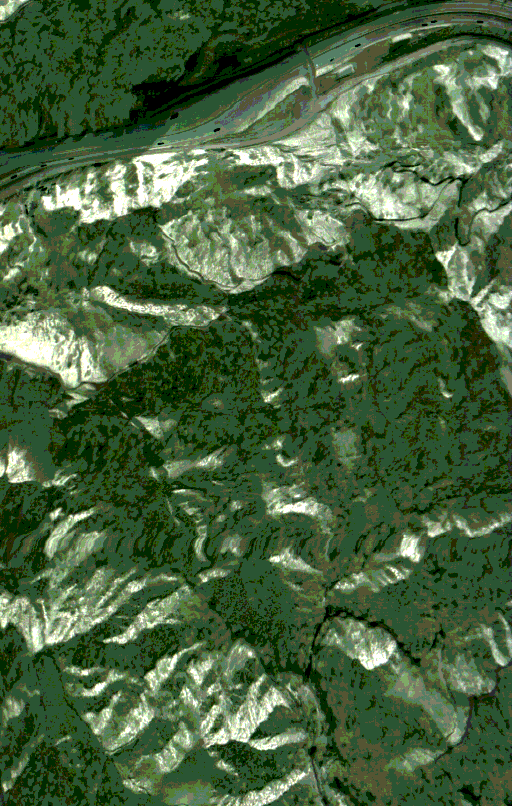
Figure 1. Portion of a false color image derived from HyTES radiance data from flight over Aliso Canyon east of Rancho Mission Viejo, California. Flight 2016-01-26.233621.
Citation
Hook, S.J., G.C. Hulley, T.T. La, G. Rivera, W.R. Johnson, and B.T. Eng. 2026. HyTES L1 Geolocation, Facility Instrument Collection, 2013-2016. ORNL DAAC, Oak Ridge, Tennessee, USA. https://doi.org/10.3334/ORNLDAAC/2467
Table of Contents
- Dataset Overview
- Data Characteristics
- Application and Derivation
- Quality Assessment
- Data Acquisition, Materials, and Methods
- Data Access
- References
Dataset Overview
Project: HyTES
The Hyperspectral Thermal Emissions Spectrometer (HyTES) is an airborne pushbroom imaging spectrometer developed by the Jet Propulsion Laboratory (JPL). It was designed to support the previous Hyperspectral Infrared Imager (HyspIRI) mission study and has been used in several research missions since July 2012. HyTES offers high spatial and spectral resolution measurements of brightness temperature (radiance), emissivity, and land surface temperature. It operates across 256 spectral channels between 7.5 and 12 µm wavelengths. HyTES instrument has 512 pixels across track with pixel sizes in the range of 5 to 50 m depending on the flight altitude. HyTES was funded through NASA's Earth Science Technology Office (ESTO) Instrument Incubator Program (IIP).
This dataset contains Level 1 (L1) per-pixel geolocation information from the Hyperspectral Thermal Emission Spectrometer (HyTES) instrument. This is the NASA Earth Observing System Data and Information System (EOSDIS) facility instrument archive of these data. The NASA HyTES is an airborne imaging spectrometer deployed on DHC-6 Twin Otter, NASA’s ER-2, and GulfStream V aircraft, and completed its first flights in July 2012. Geolocation information includes latitude, longitude, and altitude.
HyTES was designed to provide high spectral and spatial resolution thermal infrared (TIR) data as a precursor for the Hyperspectral Infrared Imager (HyspIRI) orbital mission. It is useful for a number of applications, including high-resolution surface temperature and emissivity measurements, point sources of air pollution, and volcano observations.
NASA facility instruments operate out of a NASA research center and support multiple science disciplines, field investigations, and NASA science objectives. Facility instruments are supported by managers in the Earth Science Division (ESD) Research and Analysis Program, and/or the Earth Observation System (EOS) Project Science Office.
This Facility Instrument dataset includes the L1 geolocation files from the HyTES flights in years 2013 to 2016.
Related Publications
Hook, S.J., W.R. Johnson,and M.J. Abrams. 2013. NASA’s Hyperspectral Thermal Emission Spectrometer (HyTES). In: C. Kuenzer and S. Dech (eds). Thermal Infrared Remote Sensing. Remote Sensing and Digital Image Processing, vol 17. Springer, Dordrecht. https://doi.org/10.1007/978-94-007-6639-6_5
Hulley, G.C., R.M. Duren, F.M. Hopkins, S.J. Hook, N. Vance, P. Guillevic, W.R. Johnson, B.T. Eng, J.M. Mihaly, V.M. Jovanovic, S.L. Chazanoff, Z.K. Staniszewski, L. Kuai, J. Worden, C. Frankenberg, G. Rivera, A.D. Aubrey, C.E. Miller, N.K. Malakar, J.M. Sánchez Tomás, and K.T. Holmes. 2016. High spatial resolution imaging of methane and other trace gases with the airborne Hyperspectral Thermal Emission Spectrometer (HyTES). Atmospheric Measurement Techniques 9:2393–2408. https://doi.org/10.5194/amt-9-2393-2016
Related Datasets
Hook, S.J., G.C. Hulley, T.T. La, G. Rivera, W.R. Johnson, and B.T. Eng. 2026. HyTES Level 1 Radiance, Facility Instrument Collection, 2013-2016. ORNL DAAC, Oak Ridge, Tennessee, USA. https://doi.org/10.3334/ORNLDAAC/2476
- Level 1 radiance products associated with these geolocation data.
Hulley, G.C., S. Hook, T.T. La, G. Rivera, W.R. Johnson, and B.T. Eng. 2026. HyTES L2 Emissivity and Land Surface Temperature, Facility Instrument Collection. ORNL DAAC, Oak Ridge, Tennessee, USA. https://doi.org/10.3334/ORNLDAAC/2460
- Level 2 products derived from the L1 radiance data.
Acknowledgement
The HyTES instrument is maintained and operated by the Airborne Sensor Facility (ASF) at NASA Ames Research Center in Mountain View, California, under the oversight of the EOS Project Science Office at NASA Goddard. Data processing was conducted at NASA Ames Research Center and the Jet Propulsion Laboratory at the California Institute of Technology in Pasadena, California.
Data Characteristics
Spatial Coverage: Flight lines in California, Nevada, Utah, Arizona, Colorado, New Mexico, and Wyoming
Spatial Resolution: variable (altitude dependent)
Temporal Coverage: 2013-06-24 to 2016-01-26
Temporal Resolution: One-time estimate
Site Boundaries: Latitude and longitude are given in decimal degrees.
| Site | Westernmost Longitude | Easternmost Longitude | Northernmost Latitude | Southernmost Latitude |
|---|---|---|---|---|
| California, Nevada, Utah, Arizona, Colorado, New Mexico, and Wyoming | -121.9585 | -106.1647 | 43.3545 | 32.7943 |
Data File Information
These per-pixel geolocation data are provided in comma-separated value (CSV) format.
The file naming convention is <date>.<time>.<loc>.Line<a>-Run<b>-Segment<c>-110000-geo<var>.csv, where
- <date> = image acquisition date in YYYY-MM-DD, UTC
- <time> = image acquisition time in HHMMSS, UTC.
- <loc> = location name (e.g., “NorthDeathValley”).
- <a>, <b>, and <c> indicate the line, run, and segment, respectively, numbers of the flight scene.
- <var> = variable name: "geoLat" (latitude), "geoLon" (longitude), or "geoAlt" (altitude)
Example file names:
2016-01-26.232839.AlisoCanyonNELow.Line6-Run2-Segment01-110000-geoLat.csv
2016-01-26.232839.AlisoCanyonNELow.Line6-Run2-Segment01-110000-geoLong.csv
2016-01-26.232839.AlisoCanyonNELow.Line6-Run2-Segment01-110000-geoAlt.csv
User Note: The line dimension of the geolocation is typically slightly less than that of the radiance data due to the slight variation from nadir (as is represented in the camera model); there is not enough geolocation (GPS) information for the last few lines of the scene. Therefore, there is a mismatch of a few lines between the L1A raw scene data and the pixel geolocation data. If one is using the pixel geolocation information with L1 raw data, the mismatch should be addressed by clipping radiance data from the end of the scene. This mismatch will be the case unless the pointing/camera model significantly changes.
Application and Derivation
HyTES was designed to provide high spectral and spatial resolution thermal infrared (TIR) data. It is useful for a number of applications, including high-resolution surface temperature and emissivity measurements, point sources of air pollution, and volcano observations.
Quality Assessment
None provided.
Data Acquisition, Materials, and Methods
The Hyperspectral Thermal Emission Spectrometer (HyTES) is an airborne imaging spectrometer with 256 spectral channels between 7.5 and 12 micrometers in the thermal infrared part of the electromagnetic spectrum and 512 pixels cross-track. HyTES incorporates several technologies including a Dyson spectrometer, long, straight slit, curved diffraction grating. The first version of HyTES used a Quantum Well Infrared Photodetector (QWIP). In 2021, the QWIP was replaced by a Barrier InfraRed Detector Focal Plane Array (BIRD FPA) to improve detector uniformity. HyTES has been deployed on DHC-6 Twin Otter, NASA’s ER-2, and GulfStream V aircraft and completed its first flights in July 2012.
HyTES was developed to support the Hyperspectral Infrared Imager (HyspIRI) mission and has been flown since 2012. (Johnson et al., 2011; Hook et al., 2013). It provides high spatial and high spectral resolution data on surface temperature and emissivity (Hulley et al., 2016). Its capabilities include identification of air pollution point sources (Hulley et al., 2016a) and geological studies. Additional details about the HyTES instrument are available at https://hytes.jpl.nasa.gov.
The included files hold per-pixel geolocation information, namely latitude, longitude, height, and ray-path length. The line dimension of the geolocation data is typically slightly less than that of the radiance data. Due to the slight variation from nadir (as is represented in the camera model), there is not enough geolocation (GPS) information for the last few lines of the scene. Therefore, there is a mismatch of a few lines between the raw scene data and the pixel geolocation data. If one is using the pixel geolocation information with L1A raw data, the mismatch should be addressed by clipping data from the end of the scene. This mismatch will be the case unless the pointing/camera model significantly changes.
Table 1. HyTES Instrument specifications.
| Instrument Characteristic | Specification |
|---|---|
| Mass (Scanhead) | 12 kg |
| Power | 400 W |
| Volume | 1 m x 0.5 m (cylinder) |
| Number of pixels x track | 512 |
| Number of bands | 256 |
| Spectral Range | 7.5 - 12 μm |
| Spectral Sampling Interval | 4.5 μm/256, i.e. 17 nm |
| Frame speed | 35 or 22 fps |
| Integration time (1 scanline) | 28 or 45 ms |
| Total Field of View | 50 degrees |
| Calibration (preflight) | Full Aperture Blackbody |
| Detector Temperature | 40 K |
| Spectrometer Temperature | 100 K |
| Slit Length and Width | 20 mm x 39 μm |
| IFOV | 1.7065999999999999 |
| Pixel Size/Swath at 2,000 m flight altitude | 3.41 m/1868.33 m |
| Pixel Size/Swath at 20,000 m flight altitude | 34.13 m/18683.31 m |
| Saturation Temperatures | see Figure 2 |
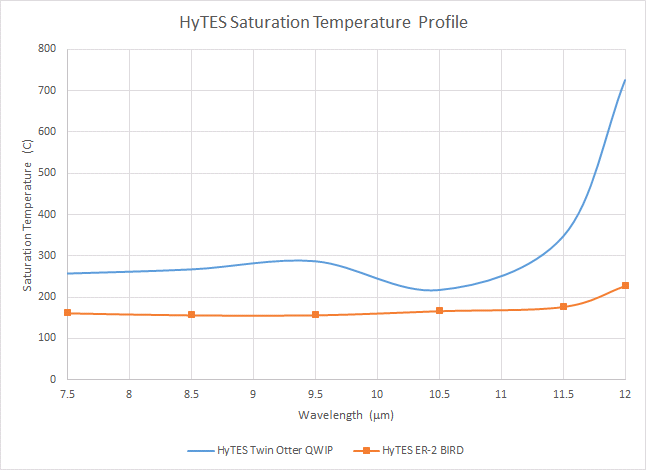
Figure 2. Saturation temperature profiles for QWIP and BIRD FPA photodetectors. The 2013-2016 flights used the QWIP sensor.
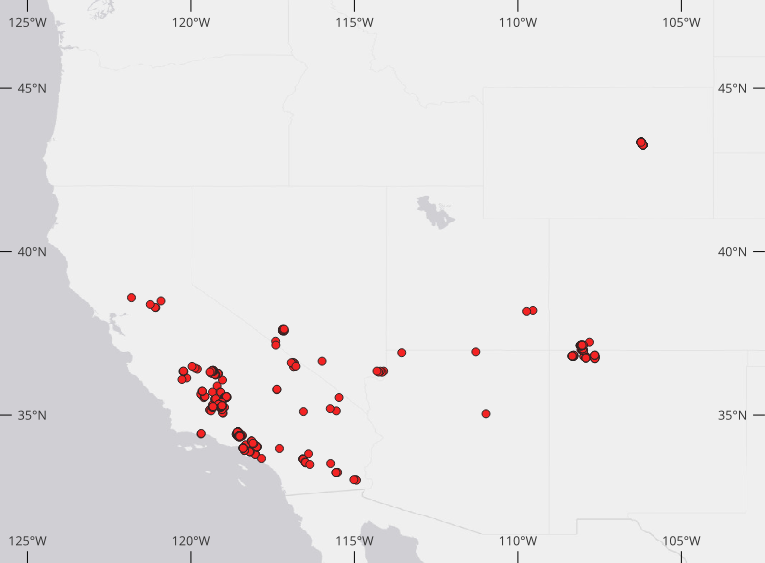
Figure 3. Locations of HyTES flights in 2013 to 2016.
Data Access
These data are available through the Oak Ridge National Laboratory (ORNL) Distributed Active Archive Center (DAAC).
HyTES L1 Geolocation, Facility Instrument Collection, 2013-2016
Contact for Data Center Access Information:
- E-mail: uso@daac.ornl.gov
- Telephone: +1 (865) 241-3952
References
Hook, S.J., G.C. Hulley, T.T. La, G. Rivera, W.R. Johnson, and B.T. Eng. 2026. HyTES Level 1 Radiance, Facility Instrument Collection, 2013-2016. ORNL DAAC, Oak Ridge, Tennessee, USA. https://doi.org/10.3334/ORNLDAAC/2476
Hook, S.J., W.R. Johnson, and M.J. Abrams. 2013. NASA’s Hyperspectral Thermal Emission Spectrometer (HyTES). In: C. Kuenzer and S. Dech (eds). Thermal Infrared Remote Sensing. Remote Sensing and Digital Image Processing, vol 17. Springer, Dordrecht. https://doi.org/10.1007/978-94-007-6639-6_5
Hulley, G.C., R.M. Duren, F.M. Hopkins, S.J. Hook, N. Vance, P. Guillevic, W.R. Johnson, B.T. Eng, J.M. Mihaly, V.M. Jovanovic, S.L. Chazanoff, Z.K. Staniszewski, L. Kuai, J. Worden, C. Frankenberg, G. Rivera, A.D. Aubrey, C.E. Miller, N.K. Malakar, J.M. Sánchez Tomás, and K.T. Holmes. 2016. High spatial resolution imaging of methane and other trace gases with the airborne Hyperspectral Thermal Emission Spectrometer (HyTES). Atmospheric Measurement Techniques 9:2393–2408. https://doi.org/10.5194/amt-9-2393-2016
Hulley, G.C., S. Hook, T.T. La, G. Rivera, W.R. Johnson, and B.T. Eng. 2025. HyTES L2 Emissivity and Land Surface Temperature, Facility Instrument Collection. ORNL DAAC, Oak Ridge, Tennessee, USA. https://doi.org/10.3334/ORNLDAAC/2460
Johnson, W.R., S. J. Hook, P. Mouroulis, D.W. Wilson, S.D. Gunapala, v. Realmuto, A. Lamborn, C. Paine, J.M. Mumolo, and B.T. Eng. 2011. HyTES: Thermal imaging spectrometer development. IEEE Explore: Conferences, 2011 Aerospace Conference, Big Sky, Montana, USA. https://doi.org/10.1109/AERO.2011.5747394