Documentation Revision Date: 2026-05-14
Dataset Version: 1
Summary
There are 10 files in ICARTT V1.1 (.ict) format in this dataset.
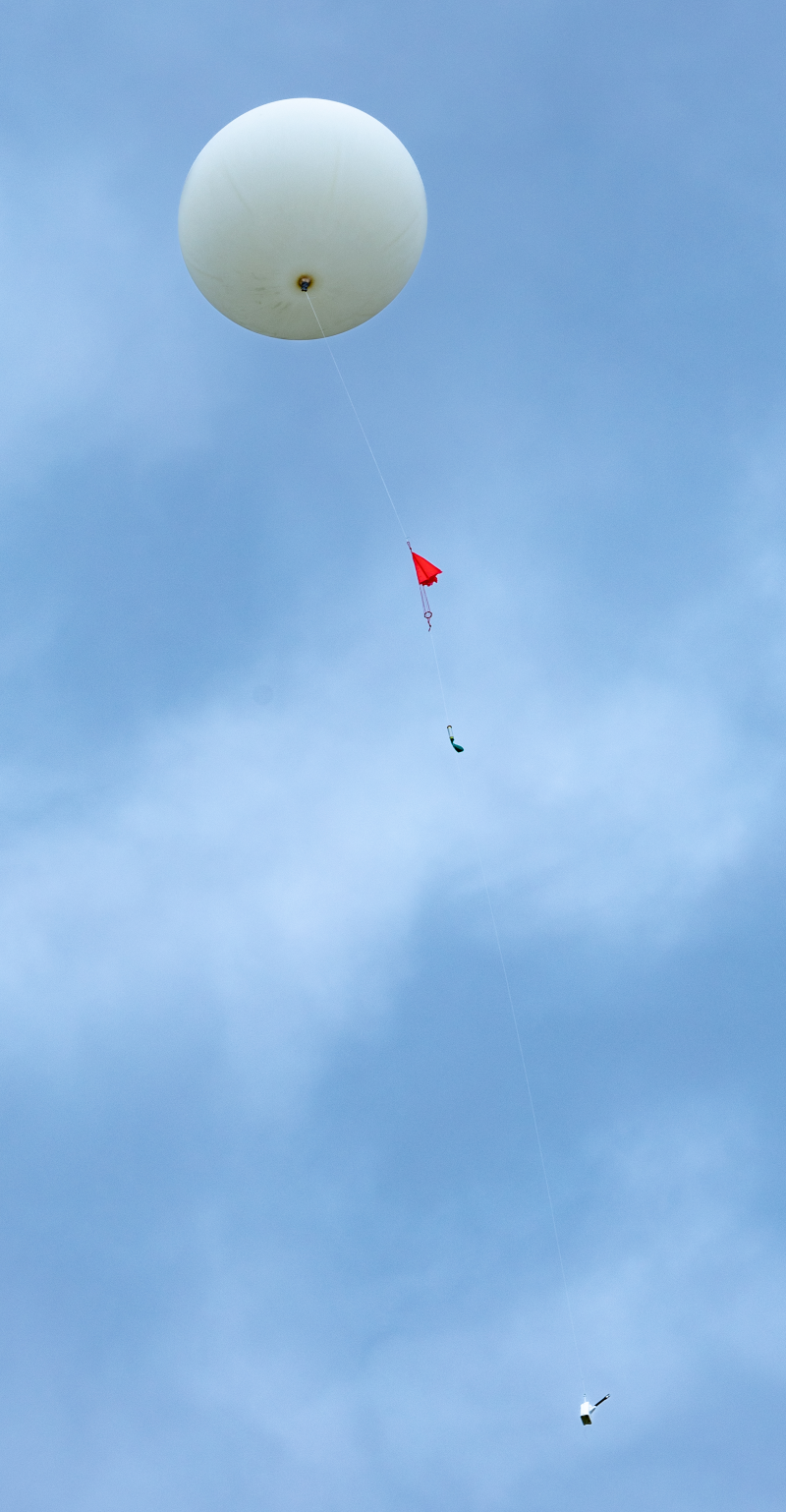
Figure 1. A weather balloon flying a radiosonde.
Citation
Pangle, P., and J. Fowler. 2026. FireSense: Balloon Vertical Profile Measurements, Fort Drum, NY, USA, 2024. ORNL DAAC, Oak Ridge, Tennessee, USA. https://doi.org/10.3334/ORNLDAAC/2497
Table of Contents
- Dataset Overview
- Data Characteristics
- Application and Derivation
- Quality Assessment
- Data Acquisition, Materials, and Methods
- Data Access
- References
Dataset Overview
This dataset contains ten vertical atmospheric profiles collected with balloon-based radiosondes in Upstate New York (Fort Drum) during the April 2024 solar eclipse. The data includes static air pressure, static air temperature, relative humidity, and wind speed and direction, latitude and longitude. Acquired by balloon-based Graw radiosondes under the FireSense Nationwide Eclipse Ballooning project, these high-resolution observations of atmospheric state variables are critical for analyzing transport and mixing processes. This dataset offers key insights into how atmospheric structure evolves in response to the eclipse. The measurements were made between the surface and approximately 28 km MSL.
Project: FireSense
The FireSense project aims to improve U.S. wildland fire management by working with operational agencies to refine and deliver NASA’s unique Earth science and technological capabilities. FireSense focuses on four types of assessments to support decisions before, during, and after wildland fires: pre-fire fuel conditions, active fire dynamics, post-fire impacts and threats, and air quality forecasting. Each type of assessment is co-developed with wildland fire management stakeholders. Through co-development of technology and data-informed tools, FireSense is intended to enable a transition from reactive to proactive fire response by facilitating increased preparedness for and co-existence with fire. To accomplish this, the FireSense team collaborates with resource managers, policymakers, and stakeholders at all levels. Since the fall of 2023, FireSense has run an annual airborne and field component where the project team tests and develops improved capabilities and technologies for transfer to stakeholders. FireSense leverages multiple airborne instruments, including the MODIS/ASTER Airborne Simulator (MASTER), the Uninhabited Aerial Vehicle Synthetic Aperture Radar (UAVSAR), the Airborne Visible/Infrared Imaging Spectrometer 3 (AVIRIS-3), the Scanning L-band Active Passive (SLAP), and the San Jose State University Wildfire Imaging System (SWIS).
Related Dataset
Pangle, P., and J. Fowler. 2026. FireSense: UAS Vertical Profile Measurements, Fort Drum, NY, USA, 2024. ORNL DAAC, Oak Ridge, Tennessee, USA. https://doi.org/10.3334/ORNLDAAC/2486
- Data collected during the April 2024 solar eclipse using an Unmanned Aircraft System (UAS) and radiosonde from the surface to 3.5 km MSL
Acknowledgements
This work was supported by the National Space Grant College and Fellowship Project and NASA FireSense Project. The University of New York-Albany provide data for the sounding comparisons, and Fort Drum (U.S. Army) provided access and airspace deconfliction.
Data Characteristics
Spatial Coverage: Fort Drum, New York, US
Spatial Resolution: Irregular from the surface to <28 km
Temporal Coverage: 2024-04-08 (during a solar eclipse)
Temporal Resolution: 1 s with sampling interval at 2 s
Study Area: Latitude and longitude are given in decimal degrees.
| Region | Westernmost Longitude | Easternmost Longitude | Northernmost Latitude | Southernmost Latitude |
|---|---|---|---|---|
| Fort Drum, New York, US | -75.5416 | -74.4989 | 44.2759 | 43.9078 |
Data File Information
There are 10 files in ICARTT V1.1 (.ict) format (Aknan et al., 2013) in this dataset.
The no-data value is -9999
The file naming convention is FireSense-NewYork-FortDrum-Balloon_PROFILE_<YYYYMMDDhhmmss>_<RX>.ict, where
- <YYYYMMDDhhmmss> is the sampling start date-time in Coordinated Universal Time (UTC) (e.g., "20240408120014")
- <RX> is the data revision number (e.g., "R0")
Example file name: FireSense-NewYork-FortDrum-Balloon_PROFILE_20240408120014_R0.ict
Table 1. Variables in the ICARTT data files
| Variable Name | Units | Description |
|---|---|---|
| Latitude | degrees north | Latitude of measurement |
| Longitude | degrees east | Longitude of measurement |
| P | hPa | Static air pressure (calculated) |
| T | degrees C | Static air temperature |
| Hu | percent | Relative Humidity over water |
| Ws | m s-1 | Wind Speed |
| Wd | degrees | Wind Direction |
| Altitude | m | Altitude of measurement |
| D | k m-3 | Instrument/intermediate variable density |
| Rs | m s-1 | Instrument/intermediate Variable Rise Rate |
Application and Derivation
High-temporal-resolution vertical profiles acquired during the solar eclipse offer valuable insights into the influence of solar radiation on atmospheric structure, which is essential for characterizing atmospheric transport and mixing dynamics.
Quality Assessment
The FireSense team chose Graw balloon-borne radiosondes as the profile reference measurement in the field based on The Global Climate Observing System (GCOS) Reference Upper-Air Network’s (GRUAN) assessment of radiosonde intercomparisons. Currently GRUAN integrates high-quality Graw radiosondes into a 30-40 site global network to provide precise, traceable vertical profiles of essential climate variables (temperature, humidity, pressure) from the surface to the stratosphere. These measurements are used to calibrate satellite data and monitor long-term climate trends. The uncertainty values cited below are based on manufacturer specifications for the Graw Radiosonde DFM-17:
- Temperature Accuracy: <0.2 degrees C
- Pressure Uncertainty: <1 hPa
- Relative Humidity Uncertainty: <3%
- Wind Speed Uncertainty: <0.1 m s-1
- Wind Direction Uncertainty <1 degree
Data Acquisition, Materials, and Methods
Site selection was made based on location along the total solar eclipse path, as well as having project permissions that provided access to restricted airspace with a high enough ceiling to allow for flight deconfliction and full Planetary Boundary Layer (PBL) sampling. Additionally, there was a need for enough space to provide launch capabilities of reference sensors for validation efforts.
The measurements were made between the surface and approximately 28 km MSL. The instrument on the balloon was the Graw Radiosonde DFM-17 responsible for pressure, temperature, and relative humidity measurements.
Data Access
These data are available through the Oak Ridge National Laboratory (ORNL) Distributed Active Archive Center (DAAC).
FireSense: Balloon Vertical Profile Measurements, Fort Drum, NY, USA, 2024
Contact for Data Center Access Information:
- E-mail: uso@daac.ornl.gov
- Telephone: +1 (865) 241-3952
References
Aknan, A., Chen, G., Crawford, J., and E. Williams. 2013. ICARTT File Format Standards V1.1. NASA Earth Science Data and Information Systems Standards Coordination Office. https://www.earthdata.nasa.gov/s3fs-public/imported/ESDS-RFC-019-v1.1_0.pdf
Graw Radiosonde DFM-17: https://www.graw.de/products/radiosondes/radiosonde-dfm-17
Pangle, P., and J. Fowler. 2026. FireSense: UAS Vertical Profile Measurements, Fort Drum, NY, USA, 2024. ORNL DAAC, Oak Ridge, Tennessee, USA. https://doi.org/10.3334/ORNLDAAC/2486